
WooCommerce and OpenCart can integrate MCP 2026 today—here's how
July 20, 2026 · 6 min read
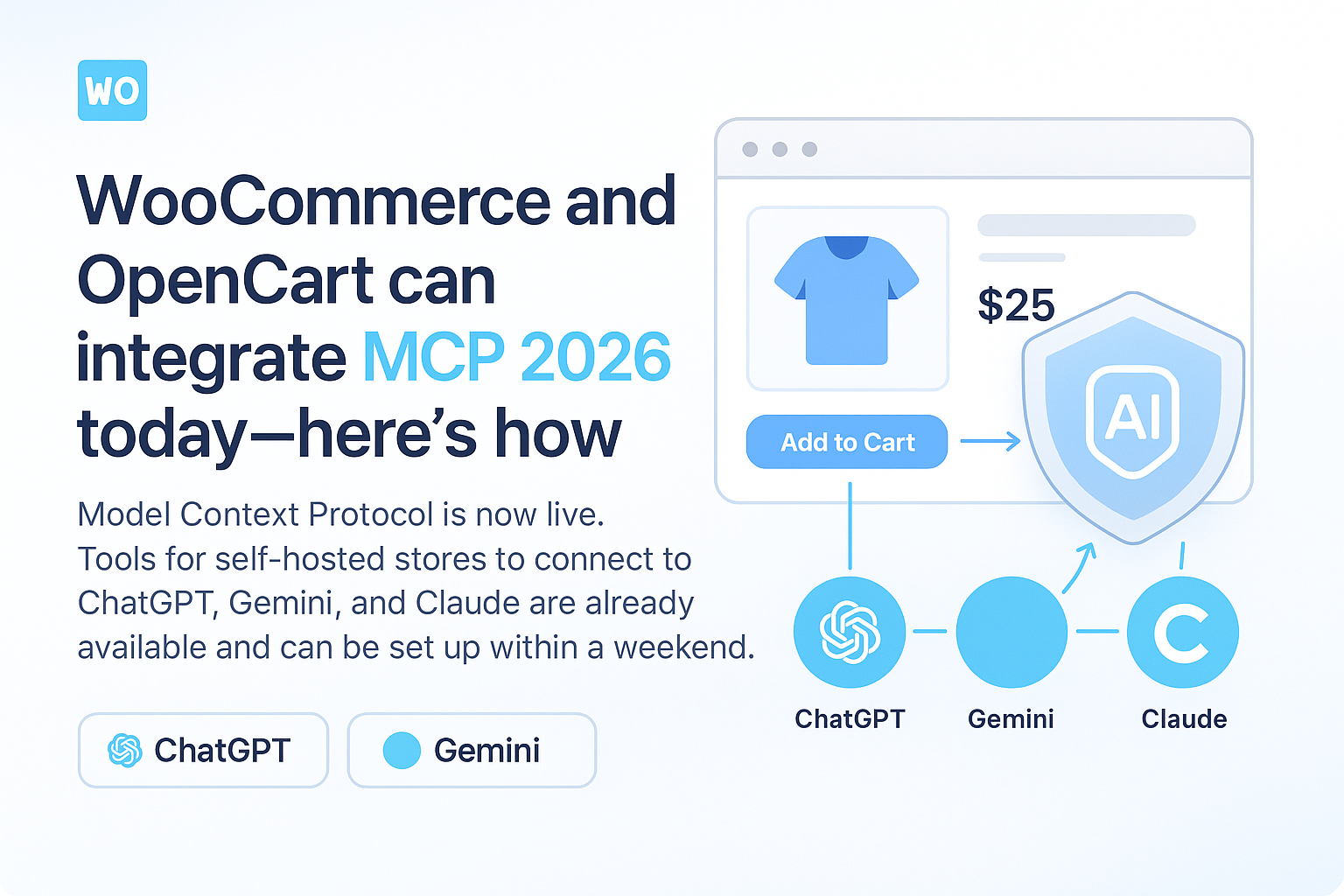
July 28, 2026 — The final version of the Model Context Protocol (MCP) — the standard for how AI models talk to online stores — has reached its final version. What does this mean for your online shop in detail?
So even though it’s only this month that you can start setting up your store with MCP, there are many platforms and shops that already have MCP-support in place. So WooCommerce shops can already use the official MCP-support in core for example, as well as OpenCart shop implementations by the community.
Below is a detailed explanation of the changes made, why you should care as a store owner, and steps to get your store up and running with MCP support in this updated model year.
What MCP 2026 actually does
An MCP server is essentially a bridge between a store and the AI ‘agents’ of ChatGPT, Gemini and other chatbots.
When the customer asks ChatGPT (or any other AI agent) for example: “What are waterproof hiking boots like?”, this inquiry is turned into a set of queries that are distributed to all stores that expose an MCP server for this agent. Here is what happens for each store: 1) Does the store sell hiking boots (of any type)? 2) If so, what are the available colors for those hiking boots? 3) What are the prices for those hiking boots? 4) How fast does the store typically ship out items to a customer with the zip code 10001? 5) What are the store’s return policies?
The MCP Server responds in real time to the AI’s request and the results are then ranked by the AI for the customer. The customer then selects the best store from the ranked list of stores to complete their purchase online without ever having to visit the store’s website.
This is not theoretical. This is happening now.
Before MCP was released there were many ways to integrate a shop with an AI. The way to integrate OpenAI’s ChatGPT with a shop would be different from the way to integrate Google’s LaMDA with a shop, and different again from the way to integrate Claude with a shop. In addition to breaking, the specs for the integrations would often be very incomplete. The specs would define how to do a search, how to add a product to the cart, how to check out. And that would be it.
MCP unifies all of that. One protocol. Every agent. A consistent data format.
Three big changes in MCP 2026
Stateless by design. MCP 2026 does not require a store's servers to store session data for connections with AI agents. As an example, a server of a store integrating ChatGPT for searching for waterproof hiking boots would not store information about the agent searching for such products. Also, information about an agent checking out from such a store would not be stored. If a store has thousands of daily connections with AI agents, this can become very expensive to store and become fragile very quickly.
The MCP 2026 Agent is Stateless, by Design. This means that for every request that the Agent makes to your Server, the Agent connects, makes the request, and then disconnects. Your Server does not have to store any session data from the Agent. This allows your Server to scale to any number of Agents connecting to your Server, to handle any volume of requests, all while saving a lot of money by not having to run an expensive Server to handle the traffic.
Extensions are first-class. The previous MCP environment for Agent-Space supported a set of core actions on a store, like search products, add to cart and checkout for online orders. But that’s not all there is to running a store. Now in MCP 2026 environment for Agent-Space, any capability of a store can be declared as an extension and become first-class support in Agent-Space
You can declare as many capabilities as your store can support (e.g. real time inventory, same day shipping to NYC, processing returns within 24 hours). Agents will find your store in agent-space and use the competitive advantage that you expose.
Your competitive advantage in agent-space is exactly what you expose.
Long-running tasks. As mentioned previously, Agent sessions in Old MCP were typically of a few back-and-forth exchanges to complete a task. However, many stores deal with B2B orders and high-touch returns that would need multi-step processes to complete an order.
MCP 2026 supports long-running Tasks which update the agent for each step in the process. For example, an online store’s workflow for placing an order might be: Order accepted… payment confirmed… shipping label printed… tracking is ABC123. This is how agents will process B2B orders and handle returns in a few years.
Longer running tasks like complex B2B orders and even high touch returns in online stores will be managed by AI agents in the next few years.
WooCommerce: official support shipped
For WooCommerce there is now also official support for MCP 2026 in the core of WooCommerce from version 8.5. As described here https://developer.woocommerce.com/2025/10/03/ai-agentic-commerce-in-woocommerce/ you can get it up and running within a few lines of code in your terminal.
Note that setting up an MCP for WooCommerce stores is a 4 step process as outlined below: The first step to setting up an MCP server for WooCommerce stores is to create a store-specific directory and use composer to install the mcp_server_packages in that directory. For example, on a WordPress installation stored in /var/www/wordpress/wp-content, the directory for the mcp_server would be /var/www/wordpress/wp-content/mcp_woocommerce_store_123456. Once that store-specific mcp_server directory is set up, then setup the mcp_endpoints for product search, for order management, and for checkout. After those 3 mcp_endpoints have been setup for a WooCommerce store, then for each store, one would register the store’s capabilities with an AI engine (like the AI Engine shown below) or with a Google Cloud dashboard (like the Google Cloud Dashboard shown below). Once a store’s capabilities have been registered with an AI engine or with Google Cloud, then one would test the agent to see that it is able to search for products and perform other tasks for the WooCommerce store.
Full guide: https://developer.woocommerce.com/2025/10/03/ai-agentic-commerce-in-woocommerce/
A number of commerce platforms have now been made available to store owners with managed implementations of MCP, including for example the AI Engine for WooCommerce and for Shopify stores.
OpenCart: community options exist
Until then, OpenCart store owners can already benefit from MCP functionality thanks to several community-driven projects that implement and support the various aspects of agent-commerce in your store.
AgenticCart: A currently under development store plugin that will enable customers of store owners to integrate product data, the checkout process and all orders from their store into Agents processing long running Tasks via the Agentic Commerce Protocol (ACP). That is fully mapped 1:1 to the MCP 2026 API.
Dreamvention's MCP for OpenCart: As I mentioned above for AgenticCart, for OpenCart the best solution for having MCP 2026 support out of the box, is Dreamvention's MCP for OpenCart extension. The extension is 100% MCP 2026 compliant, it supports real time inventory, live pricing, shipping calculus, returns workflow and more. The extension has been custom made to work with the OpenCart data model, so it fits perfectly with how OpenCart stores are structured.
Shopware/Systeme.io patterns: Also open platforms (such as Shopware and Systeme.io) have published reference implementations on how to handle traffic from AI agents. So it might also be worth to fork such an implementation for OpenCart.
Dreamvention’s MCP for OpenCart and AgenticCart (Agentic Commerce - for OpenCart) already bring full support of shop systems integration to OpenCart users. What can you wait for until Q4 2026 for when OpenCart core will get support for MCP? Six months of agent-traffic data while your competitors will be fighting to get their online store to be Agentic-Commerce-enabled?
Wait until OpenCart core supports MCP features or gain 6 months of traffic from agents while your competitors are struggling to set up their online stores!
The setup checklist
Whether WooCommerce or OpenCart:
1. Audit your data. Use https://dreamvention.com/scan (30 seconds, free) to see what data your current agents read and what is missing for them.
2. Choose your MCP server. For WooCommerce this will be either the official core functionality (once it has been released) or a managed service from a partner, for OpenCart there is AgenticCart and also Dreamvention’s version of MCP for OpenCart.
3. Structure your data. Your MCP server will expose the data about your products (product titles, descriptions, prices, etc.). Make sure this data is accurate and up-to-date.
**4. Set up Real Time Update (as fresh data as possible). In the shopping environment the latest data is the highest quality data (fresh data from the latest store updates versus data from the night before). A product could have been available yesterday and be out of stock today. If a shopping agent gets the latest data for every store that has data available for that shopping agent’s query then it will have the most up-to-date information (it will know that the product is out of stock today). The agent would not have the same amount of quality information if it fetched the store’s data in a nightly sync. The data fetched in the nightly sync would show the product to be in stock for today when in reality the product is out of stock today.
5. Register with platforms. Here you can see how to register with OpenAI’s and Google’s admin dashboards, where you need to input the MCP server’s URL and credentials (takes 10 minutes to set up).
6. Test with ChatGPT. Search in ChatGPT (enabled in Agent Mode) for your products in a category and price range. If the AI shopping agent finds your online store, all your work has paid off.
Why this month matters
The brand new MCP 2026 specification has just been finalized on the 28th of July. Thus as of today any new shopping agent for AI for shopping (MCP) that is released will comply with the newly specified MCP 2026 standard.
Those who implement MCP in August/September will have a 6 month window of lead time over the deluge of other enterprise retailers who also have to move to MCP in November/February.
6 months of data for the shopping agents as to which customers to send to your store; 6 months of tweaking and fine-tuning the various parts of your shopping agent-enabled store to make it the absolute best it can be to handle all the products that various agents will be interested in; to work out the best price to list your products at to get the agents to come and shop at your store; to work out which keywords and phrases that the agents will use when searching for your products; 6 months of lead time to fine-tune your shopping agent-enabled store before the floodgates open and all of the big enterprise retailers launch their own shopping agent-enabled store.
Retailers will be set up with MCP by end of February 2027. The remainder of 2027 will be differentiation between retailers for their store using AI shopping agents based on quality of data, and how fast they are able to adapt and make changes to better use the shopping agents for sending best customers to their store. The leaders of the pack will be the early adopters.
Will you be one of them?
Next step
Dont Wait for OpenCart Core Support - Start This Month
For WooCommerce: check what version you are running and follow the steps to implement an MCP for that version.
For OpenCart: pick AgenticCart or contact Dreamvention.
Make sure your current data (as it is) is audited to see what is currently being read by the shopping agents for your online store; Set up and organize the data that will be read by the agents for shopping at your online store; Make the data read by the online shopping agents for your store to be real time (as the stores are updated) to out compete other online agents
By October you will know if these new shopping agents work for your store or not. By February of next year you can start to fine-tune for them.
By 2027, you will be ahead of the game, when everyone else finds out that MCP is not so theoretical and that you will have to start optimizing for shopping agents.
Ready to automate your OpenCart store?
You know OpenCart inside out. The next step is turning your store into an AI salesperson that never sleeps — answering buyers, building carts and taking orders while you run the business.
Learn about agentic commerceGet AI Commerce Tips
5 expert tips to grow your store with AI agents.
No spam — unsubscribe with one reply.
Read next
MCP 2026 Release Candidate: The new standard for AI agent ecommerce
Model Context Protocol hits its final specificatio…
Read →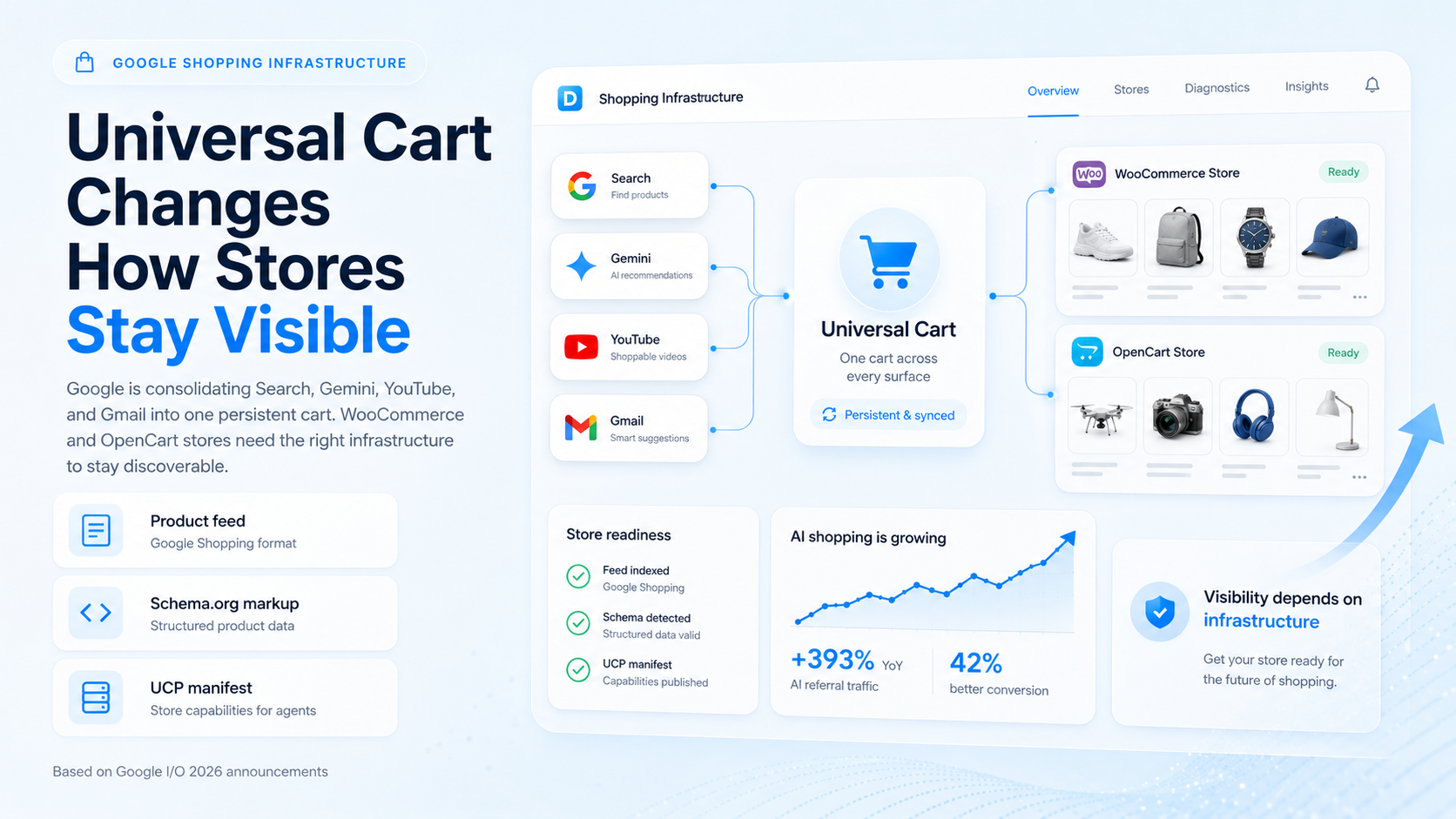
Google Universal Cart and AP2: What self-hosted stores need to know
Google's new shopping infrastructure consolidates…
Read →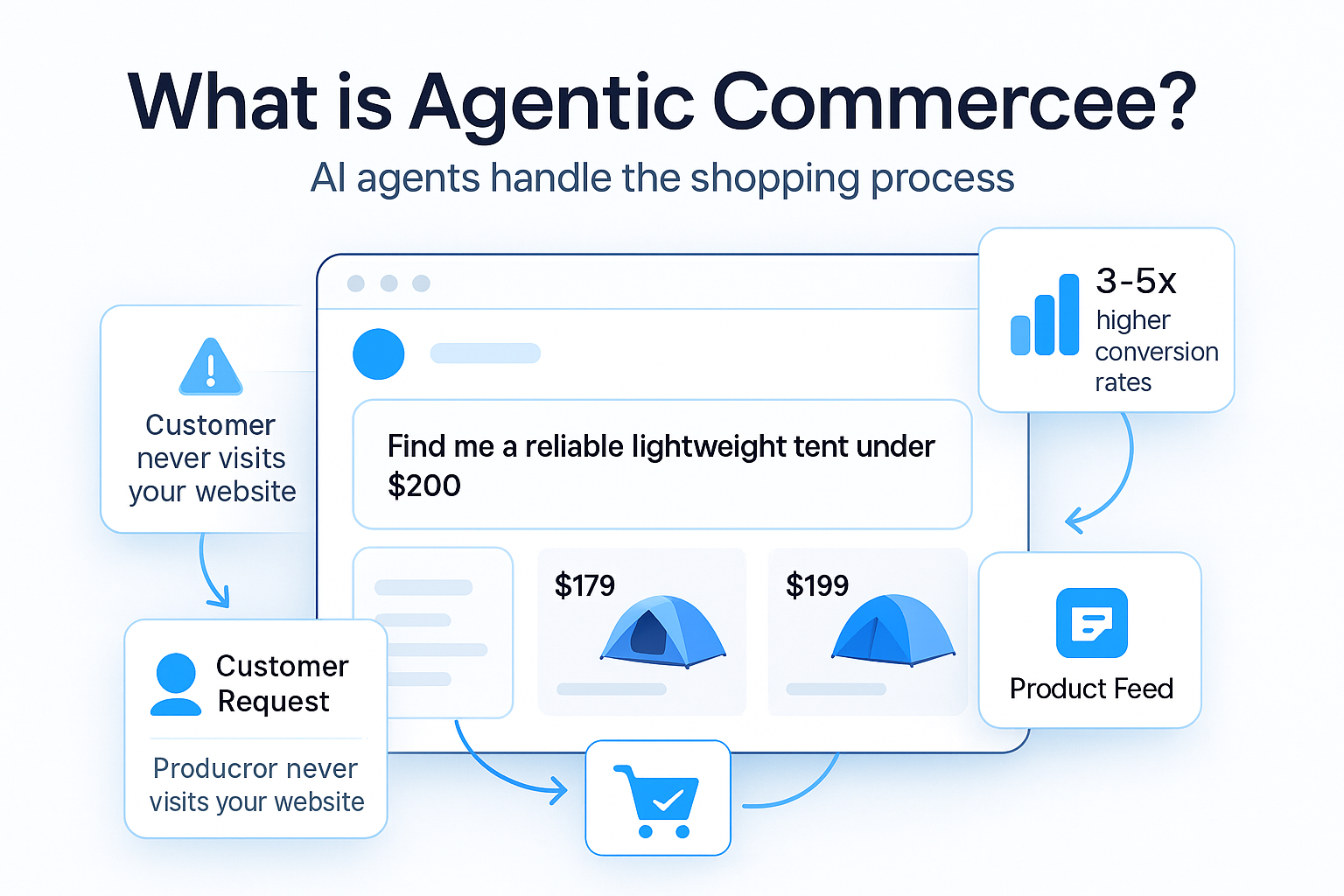
What is Agentic Commerce? How AI Agents Are Changing E-commerce (2026)
Introducing Agentic Commerce for you and your stor…
Read →Put a sales agent on your store
It knows your catalog, recommends, takes orders — on your site and in ChatGPT. Built for you — live in days, not months.