
MCP 2026 Release Candidate: The new standard for AI agent ecommerce
July 17, 2026 · 4 min read
A Huge Change in AI for All Online Stores Happened Last Friday. Here is What it Means for Your WooCommerce or OpenCart Store. The Model Context Protocol (MCP) has reached its final spec version on Friday, July 28, 2026. We wrote about it before. And this is not a new version of anything that has been released before. This is the final version. The “everything changes from here” spec.
A huge release happened in the AI world today (July 28, 2026) for all WooCommerce and OpenCart stores. The final release of the Model Context Protocol (MCP) has been released, MCP is the new lingua franca (language) for all AI agents (ChatGPT, Gemini, Claude, etc) to be able to talk to all servers (stores) in the world. As MCP was supposed to fix, all the old integrations of AI agents to stores were all custom and had many problems. So a full rewrite was done, removing the old problems, and creating a fully new architecture. The new architecture of MCP is stateless (no server side storage of session
Stores that are not MCP compliant by September 2026 will be invisible to the fastest growing qualified traffic for online shopping. The fastest growing qualified traffic for online shopping are AI Agents. As mentioned before, everything changed from here with the finalization of MCP (Model Context Protocol) 2026 spec on July 28, 2026. MCP is lingua franca for every AI Agent and it is developed to enable AI agents to integrate with every server or store.
What actually changed
2026 spec is totally rewritten from grounds up as a server to AI agent communication protocol.
No more server state. A key change in the new MCP spec is that the server is now “stateless”. What this means is that your server does not have to store any information about an agent that is currently connected to your server. Server state includes things like what an agent is currently doing (e.g. “this agent is currently searching for products”). As the number of agents connecting to your server increases, the amount of server side state required to service those connections can become a real problem. In a stateless system, an agent connects to your server, makes a request, and then disconnects. The agent and server have no memory of each other between connections. This makes things simpler for you (as a server administrator) in a couple of key ways. First, you do not have to worry about clearing out old state from previous connections. Second, you do not have to worry about how your server will handle large numbers of connections where each connection requires a lot of server side state.
Second: extensions are now first-class. The Model Context Protocol extensions for the new spec are a major change from prior versions of the MCP. In prior versions of the MCP there were a number of very core actions that a server could support. Extensions in prior versions of the MCP were for adding new actions that were outside of the core set of actions, but the extensions themselves were limited to the core architecture of the prior spec. The new extension architecture of the MCP 2026 spec makes extensions first-class. Rather than limiting a store to only a handful of very core actions, a store can now declare as many capabilities as the store supports. Agents that connect to a server using the MCP can then discover the extensions supported by the server and use the actions of the extensions within their own tasks. Extensions ship constantly now and a store would have to change significantly to support new capabilities of agents under prior architectures.
Long running tasks – how to handle complex workflows. Until the introduction of MCP 2026, AI Agents where limited to a few questions per session. For most online shops this was sufficient, but for online shops with more complex workflows (e.g. multi-step checkout processes) this created a huge problem. The Tasks-feature in MCP 2026 allows for agents to handle long running tasks and for the AI Agent to receive progress updates in the meantime. For example, an agent could ask a shop to process an order, and the shop would then reply to the agent that the order is processing. The AI Agent can then continue to check on the status of the order until it has been completed.
Why this matters for your store
Here's the practical impact:
I did not include the amount of traffic that you are currently getting from AI agents in the above table, as I believe it will be zero for most of you. It will be your problem in Q1 2027.
For 8 weeks, any store that implements the 2026 spec of MCP can ensure that their store is found by ChatGPT Agents, Gemini, Claude with tools and other new agents launched after July 2026. That is, their products will be searched and their store will compare prices against other stores, and qualified high-intent traffic will be sent to the store.
On the other hand, waiting to implement an AI integration until later will cause your store to be ranked by AI Engines lower than MCP compliant stores. This is not because the AI Engine is “programmed” to exclude non-MCP stores from search results. Instead, MCP stores will be able to send AI Engines better quality data, enable faster queries, access up to the minute information (like real time inventory), and more. The AI Engine will be optimized for MCP stores and perform better on them.
What you actually need to do
Step 1: See where you currently stand If you have custom AI integrations or an older version of MCP on your server it will likely NOT be working. You should check your server logs for agent activity. You should also test product searches with ChatGPT and Gemini Agents for your store and see if they can find your products and add them to your online cart. Also, test checking online store prices for products as well as checking online store return policies.
Pick an MCP server for your store. This is a great place to start. First, check if your current AI powered integration is still supported or if it’s been abandoned and is therefore broken. If you do find an integration that supports MCP look for the 2026 version. As of the writing of this post there is a 2026 compliant version of MCP for WooCommerce available from AI Engine. For OpenCart the options are currently very limited but Dreamvention supports OpenCart for MCP 2026. Hopefully the OpenCart community will support 2026 MCP as well to avoid having to go through a custom build-out for this.
Publish your store’s capabilities. Once you have set up an MCP server for your store, publish your store’s capabilities to MCP Servers. Capabilities that you would publish would be things like “I support product search”, “I have real-time inventory updates for all of my products”, “I support refunds and returns”, “I ship to all zip codes in the US”, etc. The more specific that you are with your capabilities the better off that AI Agents will be in order to take advantage of the capabilities that your store supports.
Test your implementation: Once your integration is working with AI Agents, test it out within a ChatGPT Agent session. Test searching your online store for a product. Add that product to your online store’s shopping cart. Then, find out the online store’s return policy. If the AI Agents can perform all of these tasks then AI Agents will work with your online store as well.
Watch your analytics for AI-referred traffic patterns. There will be some differences in how customers behave as compared to regular web site visitors. Typically, there will be higher conversion rates, shorter average session lengths, and higher average order values. Set up your analytics, such as Google Analytics, to track referrals using UTM parameters. This will allow you to easily segment and analyze the behavior of customers referred to your site by different AI agents.
The window is now
This window will remain open until mid-February of next year. By that time, all of the new agent integrations will have been built out using the MCP 2026 specs. If you haven’t optimized your store for the latest AI powered traffic by then, you’ll be at a significant disadvantage to your competitors. By shipping out support for the latest MCP specs in August and September of this year, you’ll have a 6 month lead on all of the other stores on the web that don’t ship out support for the new specs until after the competition has caught up in February of next year. By the time your competitors are scrambling to catch up and figure out how to best service the new AI powered traffic, you’ll already have 6 months of data on which agents drive the best customers for your products and you can then optimize your product feeds and use that data to best price your products for agent queries.
Stores that move now win.
Get AI Commerce Tips
5 expert tips to grow your store with AI agents.
No spam — unsubscribe with one reply.
Read next
ChatGPT's 11.4% conversion rate beats every traditional channel—here's why
New data shows ChatGPT-referred traffic converts 3…
Read →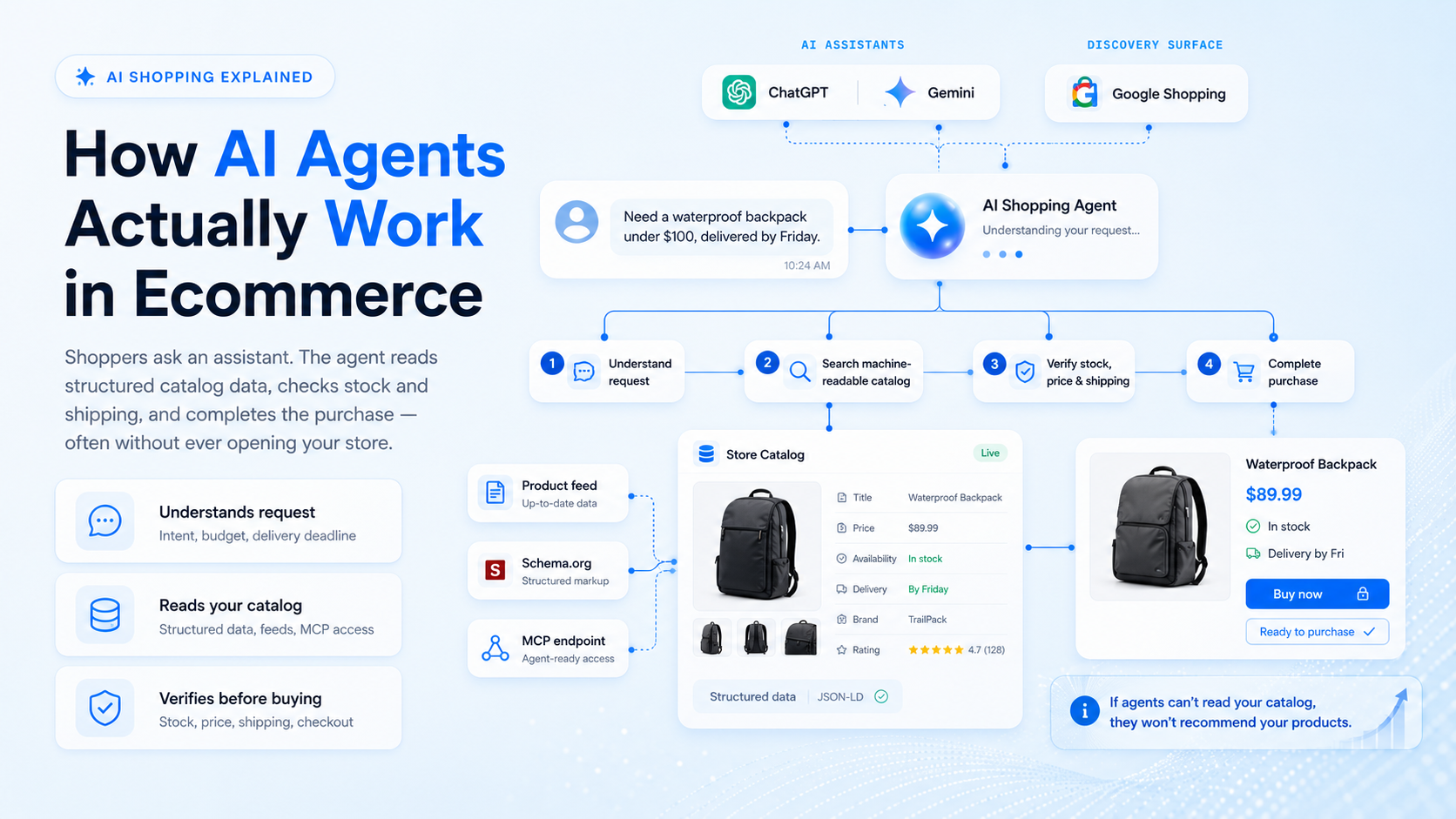
How AI agents actually work in ecommerce
Shoppers describe what they want to an AI, the AI…
Read →
MCP for ecommerce, explained for store owners
MCP is how AI assistants query your store directly…
Read →Put a sales agent on your store
It knows your catalog, recommends, takes orders — on your site and in ChatGPT. Built for you — live in days, not months.