
What is Agentic Commerce? How AI Agents Are Changing E-commerce (2026)
July 19, 2026 · 8 min read
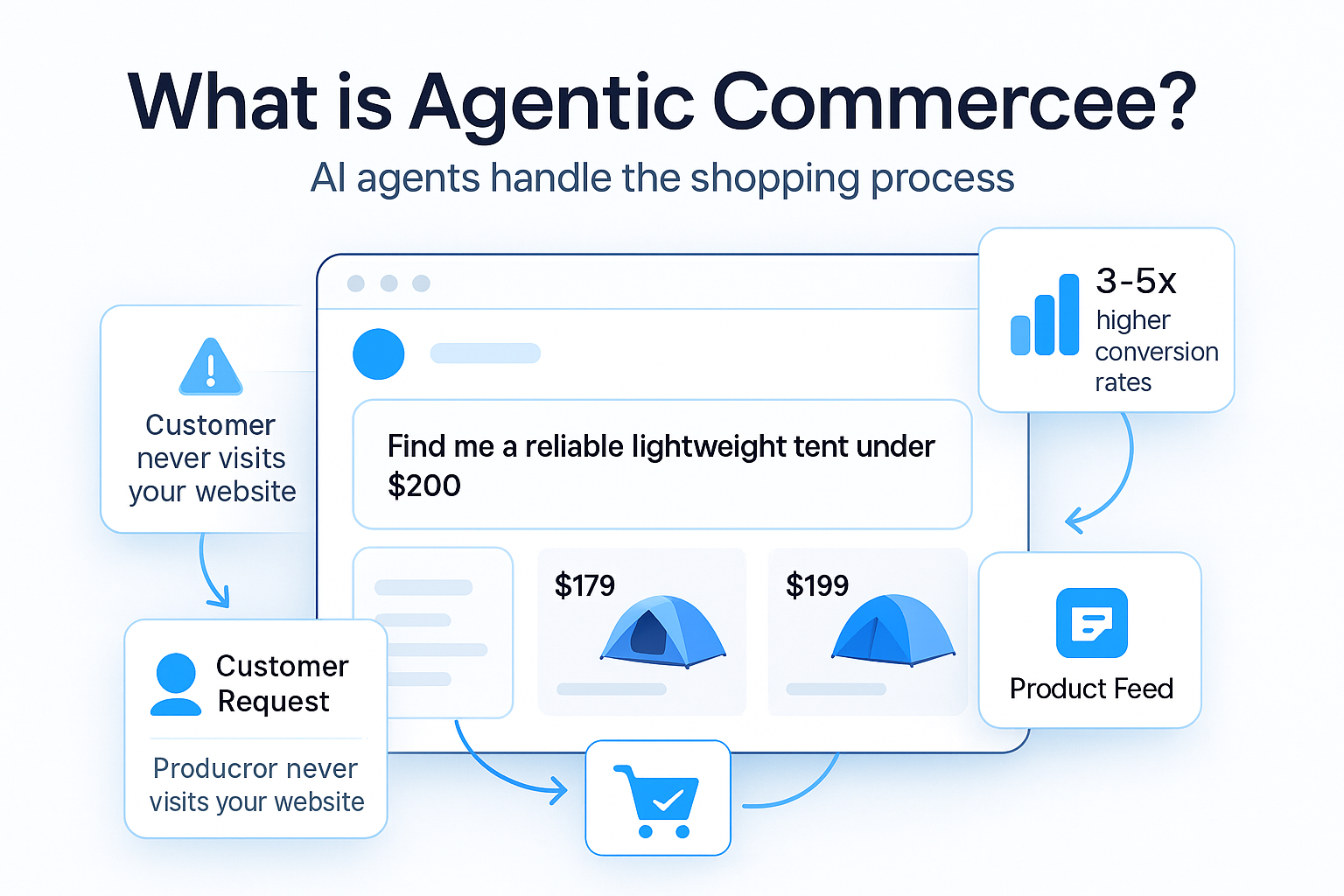
By 2026 we will largely be doing our online shopping through our AI shopping assistants who will buy for us hands off on our behalf. This new form of commerce will become the norm whereby the AI Agent ‘shops’ on our behalf to ‘find’ items such as lightweight $200 or less ‘good quality’ tents (including stockists etc.) and select the ‘best’ for us. Then proceed to purchase same. We then receive a report of potential purchases that our Agent has selected for us and we approve them on a line by line basis by confirming their purchase and have them added to our ‘shopping cart’ (eg ‘add to shopping cart’).
Agentic Commerce is already here! Salesforce Agentforce, the shopping integration in ChatGPT by OpenAI and the newly launched Universal Cart by Google are just some examples of how Agentic Commerce already works. If you have an e-commerce store that is based on OpenCart, WooCommerce or Magento then you might already have to deal with becoming invisible to a whole generation of shoppers within a short period of time if you don’t prepare your store for Agentic Commerce in the near future.
What is Agentic Commerce?
Agentic commerce is the term for e-commerce transactions where an AI agent shops on behalf of a customer and actively compares products, buys in an entirely automated fashion. This means the AI will search through a retailer’s product catalog and, based on criteria provided by the customer, search through the products to find the very best for the shopper. The agent will then purchase the product or products for the customer.
Agentic commerce differs from traditional commerce in that the customer never interacts with a website during a purchase process initiated by an agentic commerce system. Traditional commerce is contrasted with agentic commerce in the illustration below where a customer interacts with an AI-powered virtual shopping assistant that shops a web site on behalf of a customer.
Agents in Agentic Commerce perform all actions to purchase products and services on behalf of customers. Agents work with a customer’s intent to purchase products and services. This process is fast, has less friction and converts better when properly executed.
How Agentic Commerce Works: The Loop
The agentic commerce loop has five steps:
1. The Customer Request: A customer asks ChatGPT, Gemini, or another AI: ‘I need to purchase some new running shoes. I am a size 10 and I am looking to spend no more than $150. I would like to read some of the reviews that other customers have left before making a final decision and making a purchase online. The intent of the customer has been received by the AI agent.
2. Agent Queries Your Store: The agent connects to your online store via an API or MCP (Model Context Protocol) server, and in the process of attempting to fulfill the customer’s request, it queries the store for information about products that would be suitable. Information about products in your online store is typically fed into your store in the form of structured data (also known as “product data” or “catalog data”); the agent retrieves this information from the API.
3. Agent Evaluates Options: The AI Agent goes through all the products in your store that match the customer’s request. It looks at all the relevant product information (e.g. product details, reviews, prices, stock levels and return policies) for each product and ranks them from best to worst based on how well they match the customer’s request.
4. Agent Executes the Transaction: In this step the Agent adds the best products to the online shoppers shopping cart on the customers behalf and proceeds to pay for the products online. The Agent will check details such as delivery, payment terms and return policy prior to proceeding with the purchase. In some cases the Agent will have pre-approval to proceed with the purchase from the customer, in other cases the Agent will confirm all details of the transaction with the customer prior to placing the order.
5. Agent Reports Back: The AI agent will report back to the customer regarding the products that the customer wanted. For example, in the example provided above, the customer asked the AI agent to find the customer the best new running shoes. The AI agent found 3 good running shoes for the customer and added the best option to the customer’s cart. The AI agent reported back to the customer stating that the best option for the customer was added to the customer’s shopping cart. The customer’s new running shoes will arrive at the customer’s location in 2 days.
The shopping process is completed by the AI agent without human intervention. The customer and the AI agent interact until the customer authorizes the purchase. The entire process is then completed by the AI agent and completed without human intervention on the retailer’s website.
Agentic Commerce vs. Chatbots vs. AI Assistants: What’s the Difference?
Many people however are confusing agentic commerce with chatbots, AI powered human like assistant functions or even Virtual Retail solutions. While all of these form part of human – AI interactions in a retail setting, agentic commerce is a completely different and powerful retail function that is here to stay in the medium term.
Chatbots: the traditional way to have human to computer interaction via typing. In the above example, a customer asked how the customer could return an item and the computer responded with the following answer: “Our return policy is 30 days”. In this way, no agency was involved to service the customer’s question.
AI Assistants: For a number of years now people have worked with AI Assistants and Chatbots. But the major difference is that AI Assistants, as conversational programs, are able to follow a long chain of reasoning to arrive at an answer to provide an answer to a question whilst AI Assistants are able to carry out a web search on behalf of their human to arrive at an answer to a human’s question, and return links to online stores to allow the human to purchase online the item(s) required by the human such as running shoes. That’s right, as an example, you could ask the AI such as ChatGPT ‘Where can I buy running shoes’ and the AI would carry out a web search and return links to where on the web you can purchase the running shoes required by you. So in this example the human will be required to purchase the required items on-line.
AI Agents: For commerce AI Agents access a store’s product data and complete transactions (e.g. a running shoe store might program an Agent that allows people to find and purchase new running shoes). To give you a sense of this a customer might ask where to find new running shoes. The Agent’s response could be to send the customer to the running shoes page on the retailer’s site. On this page customers could then look at all the different models of running shoes and complete a purchase of the ones they wish to buy. Note that an Agent would search the retailer’s online store’s database of all products that they sell to see which would be the best match for the customer’s query.
In comparison to chatbots and AI assistants, agentic commerce is a completely new concept that differs from both aforementioned terms in a significant way. For one, the difference between chatbots and agentic commerce is that chatbots are scripted while agentic commerce is not. Furthermore, the main difference between AI assistants and agentic commerce is that while AI assistants are conversational, agentic commerce is transacted autonomously by an agent.
Real Examples: Who's Already Doing Agentic Commerce?
Salesforce Agentforce: Salesforce announced Agentforce in 2025. Agentforce is a set of tools and services developed for and by Salesforce for its customers and its developers. Agentforce allows developers to create and deploy their own agents within a company’s Salesforce implementation. These agents can then perform customer service, marketing and commerce functions for the company automatically.
ChatGPT Shopping Integration: ChatGPT can now be used for shopping. In the example image above, a user asked ChatGPT “Find me a good espresso machine” and the AI processed the query, queried retailer’s APIs, compared prices and completed the checkout for the best option within the chat.
Google Universal Cart (AP2): Google’s offering of shopping within search results, Gemini articles, YouTube videos, and Gmail emails all from a single cart. Shopify stores are automatically published within Universal Cart. Self-hosted ecommerce sites, like OpenCart, WooCommerce, and Magento sites, will need to setup an MCP server, create and publish a product feed, and then create a UCP (Unified Commerce Protocol) manifest.
Amazon's Just Walk Out: Amazon cashier-less stores use agents to track what you pick and charge your account—no checkout interaction required.
All of these are agentic commerce in action.
Why Your OpenCart, WooCommerce, or Magento Store Needs Agentic Commerce
However, by not supporting agentic commerce on your self-hosted e-commerce store (OpenCart, WooCommerce, Magento) by 2026, you’ll be making yourself invisible to an entirely new shopping channel.
Shopify will have a much easier time here since there are already partnerships with Google (OpenCart, WooCommerce, Magento etc.) and OpenAir (Google, YouTube, Gmail etc.) which make adding a store to Google’s Universal Cart for commerce very easy. In fact, every Shopify store will automatically be added to the Unified Cart for commerce (UCP) which will allow all products in that store to be available for shopping in ChatGPT shopping etc.
In the case of OpenCart, WooCommerce and Magento stores the transition to agentic commerce is possible. First they have to opt in, then they have to set up an MCP server, publish a correct product feed in a correct format and generate a UCP (Unified Commerce Protocol) manifest for their store. The UCP manifest contains information on the payment methods, the shipping zones, the tax rules and the return policies of a store. A sample JSON file for the UCP manifest can be found here.
As shopping in ChatGPT and Gemini increases over the next 12 months it is very likely that for the first time in history, more shopping will occur via Search but via Agents within Search.
Of course, agentic commerce greatly reduces the amount of friction that shopping online has (and especially having to and navigate a store’s online presence and find what you want to buy there, add to shopping cart, and then complete subsequent checkout process). That is why it has achieved conversion rates of 3x to in experiments so far.
Getting Started with Agentic Commerce
To set up your store to interact with agents there are 3 steps that you need to follow.
1. Publish a Clean Product Feed: This is a very important step in the agentic commerce process. By publishing a clean product feed to your online store, you are allowing agents to find products on your site and for customers to purchase from within the agent’s interface. This feed must be in a Google Shopping feed format (i.e. CSV or XML) and each product must have the following fields: title, description, price, stock, images, etc. Any errors in the feed can cause products not to be found by agents.
2. Set up an MCP Server: Setting up an agent-friendly store for a self-hosted e-commerce platform like OpenCart, WooCommerce or Magento requires setting up a so-called MCP server. MCP stands for Model Context Protocol. An MCP server acts as an intermediary between a store and agents and models the store’s products, prices, stock levels, etc. This server models the store’s products, etc. and makes it easy for chatbots and other AI systems to integrate with the store. There are already community-led MCP servers available for OpenCart and WooCommerce stores.
3. Create a UCP Manifest (optional): Create a JSON file at /.well-known/ucp-manifest.json including information about your store. For example: available payment methods, shipping zones, tax rules and return policies. Such a manifest can be read by agents like Google’s Gemini in order to find out how to do a transaction on your store.
With all of this in place, customers can search for items in ChatGPT, Gemini or even Google Search and find your products from your online store to buy without ever having to go to your website.
If you have no idea where to start we can do a 30 second scan of your shop and let you know what changes are required to get you up and running with Agentic Commerce. Click here to get a free scan of your shop. No email required.
The Bigger Picture: Agentic Commerce is the Future
Agentic commerce is not just another feature for online stores. For the last 25 years we have all been working on optimizing online shops for human shoppers. We have been focusing on Search Engine Optimization (SEO), on User Experience (UX) of online shops and on optimizing checkout flows. All this will still matter in 2026 but then we will also have to optimize online shops for AI agents. This is the next evolution of e-commerce.
Retailers that are the first to set up an MCP (to be able to integrate with different agents), publish a clean product feed to be able to be found by agents, and set up their online store to be agent-friendly will receive the most traffic. Retailers who do not start in time will have to compete on price, lack brand differentiation, have no traffic coming from agents and will experience margin erosion.
Time to start to set up your shop for the agents that will be shopping in there. Many competitors are already moving!
Get AI Commerce Tips
5 expert tips to grow your store with AI agents.
No spam — unsubscribe with one reply.
Read next
WooCommerce and OpenCart can integrate MCP 2026 today—here's how
Model Context Protocol is now live. Tools for self…
Read →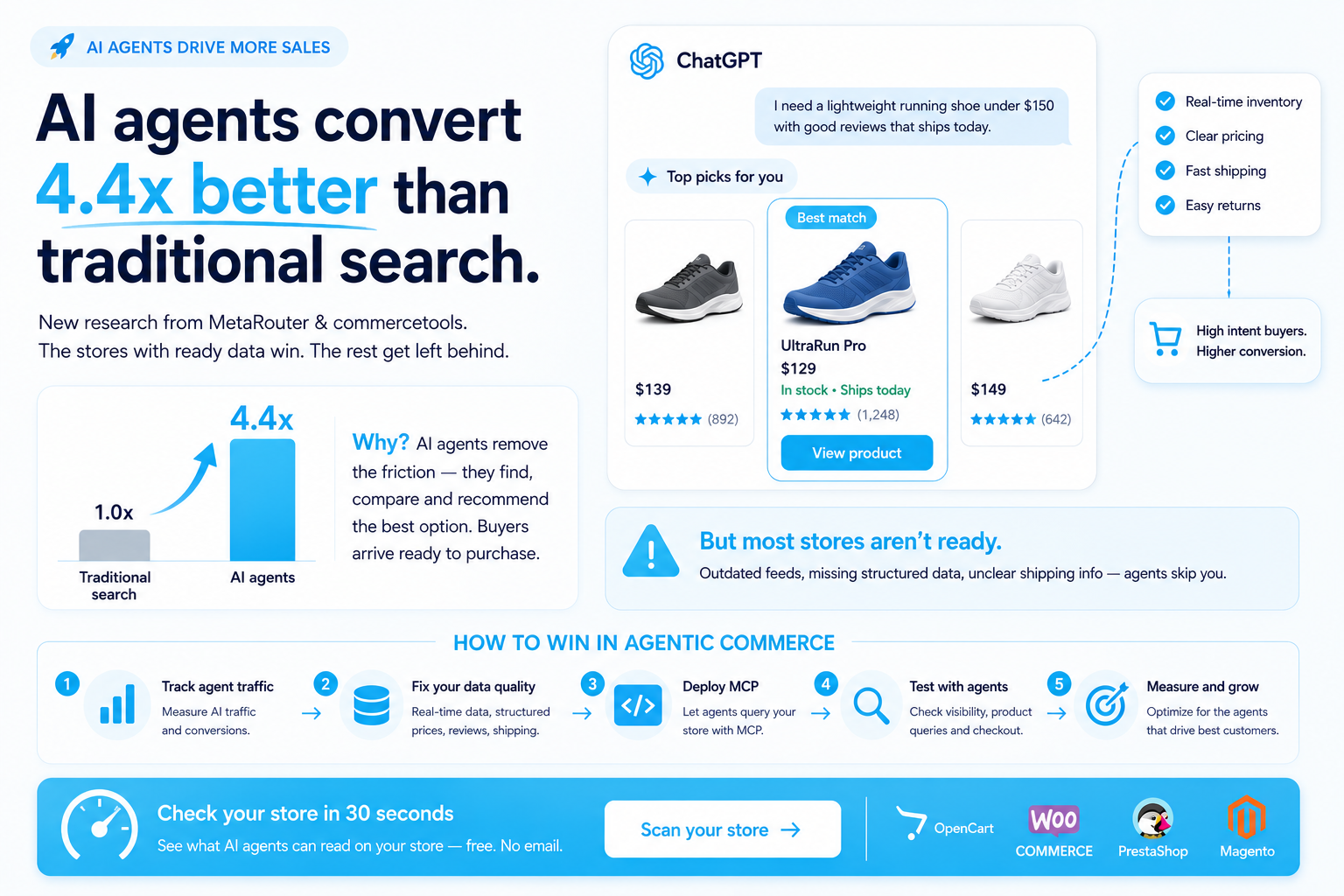
Agentic commerce has 4.4x conversion potential – but only if your data is ready
New research highlights the vast potential of AI p…
Read →
MCP 2026 Release Candidate: The new standard for AI agent ecommerce
Model Context Protocol hits its final specificatio…
Read →Put a sales agent on your store
It knows your catalog, recommends, takes orders — on your site and in ChatGPT. Built for you — live in days, not months.