
Agentic commerce has 4.4x conversion potential – but only if your data is ready
July 20, 2026 · 5 min read
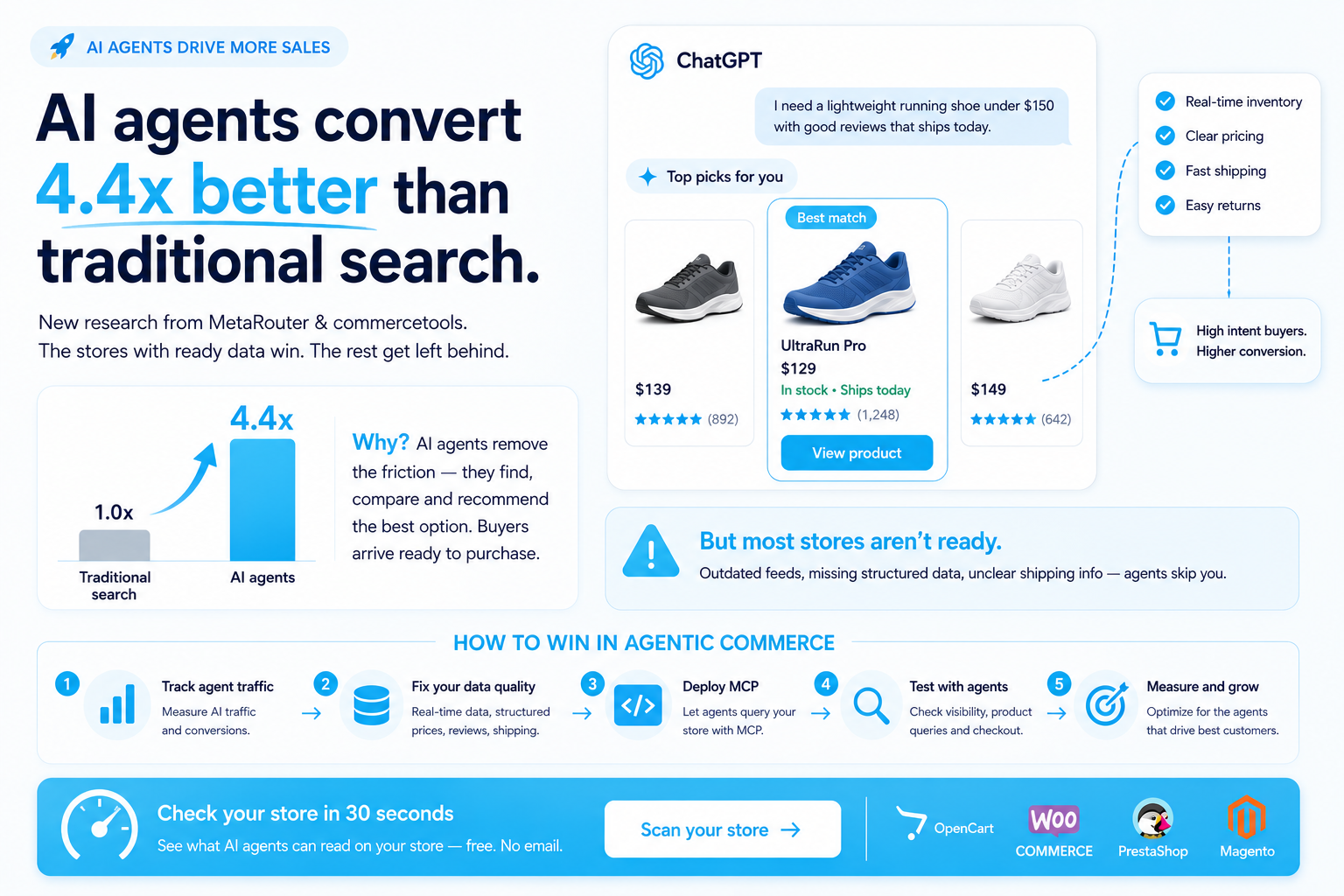
A few days ago, a very interesting joint research report by MetaRouter and commercetools was published – every store owner should read it, because it contains a lot of data about the impact of AI agents on search in online shops. And: 4.4x more conversions are generated by AI agents than by traditional search. Four point four times!
But there is a huge BUT. The data in your store has to be ready for these kinds of agents to drive more conversions for your store. The data in most stores is not ready for these kinds of AI agents.
In order to continue to grow, merchants in 2026 will be measured on their ability to measure and optimize AI driven revenue in real-time.
Where does 4.4x come from?
The typical user searching for products online starts at a search engine like Google, searching for information about products to buy such as “running shoes”. The user then clicks through to a retailer’s website, reading product reviews and comparing products and prices. The user also checks the retailer’s shipping and return policies before finally making a purchase, or not. Often the user will come back to their computer or mobile device later and purchase from another retailer’s website. Often the products that the user finally buys were not the user’s first choice. As a result, the conversion rate for product searches on retail websites is typically between 1% and 3% for most products.
Here’s an example of how a user inquiry could be processed by an AI agent and then evaluated against products offered by all of the online stores where the products are being sold: the user asks ChatGPT or Gemini the following question: “I am looking for a very lightweight running shoe. Ideally the shoe should cost no more than $150. I would also like the shoe to have the best reviews and the agent should also take into consideration the shipping time required for the products to be delivered to the user’s zip code and the return policy of the item(s) being purchased. The user’s inquiry would then be evaluated against 5,000 products that are offered by all of the online stores where the products are being sold. The agent would then rank the products based on the user’s specific search criteria and present the user with the top 3 products. The user would then click on the store where the agent determined that the user would most likely purchase the product from based on the store having real-time inventory data, the fastest shipping to the user’s zip code, and the return policy being clear to the user (i.e. a 30-day return policy).
First, consider an individual user’s behavior. The user looked up a product search term (e.g. ‘running shoes’). This user has a clear intention to purchase the product and has arrived at a store’s page for that item. Conversion rate for product search queries can rise from 1-3% to 4-15% (average: 8.5%) for stores without any barriers to purchase (i.e. ‘friction’). Thus, 4.4x increased conversion rate for a store where an AI agent sends the user who searched for running shoes to that store, is due to the agent having removed all the uncertainty and each and every potential barrier to a purchase for that user.
The problem: your data isn't ready
Here's what agents actually need to rank you:
And conversely, for a store with a product feed updated daily at 3 am, an agent searching for stock online, that has sold out of a product will not know about it for days, while the competitors with product feeds updated in real time will rank above it.
Pricing: An agent can compare your price for a product with that of 50 other stores selling the same item. Therefore, if the pricing for products on your site is buried deep within the site, perhaps behind a lot of JavaScript or requires your store to perform a lot of manual scraping in order to obtain the pricing for products on your site then the agent will determine that it is too high in friction to query your site’s pricing. Structured and queryable pricing stored in JSON would on the other hand be queryable with low friction.
Reviews: The AI agent verifies aggregated review signals to trust rank stores. Reviews that are left scattered in 3 different review platforms will not get the same ranking as aggregated reviews with an average rating that is clearly visible. Also, be aware that using fake reviews to manipulate the ranking will get detected in no time and negatively impact your ranking.
Additional data that Agents can use about a merchant include: information about a merchant’s shipping policy and the user’s transaction history with the merchant (e.g. the user’s shipping zip code, merchant’s tax rates, payment methods that the merchant accepts, etc.). Also, Agents look for a clear return policy published on a merchant’s website. If a merchant does not clearly publish a return policy on their website then Agents will flag the merchant as risky for users.
The next aspect of your store’s policies that the agents will read are your return policy. Your return policy could be clearly outlined on your site, but if it is ambiguous in some way then the agents will penalize you because customers who shop through agents do not want to take any risk when buying online.
Getting most WooCommerce and OpenCart shop’s data to 20–40% of what product search AI agents need to rank a shop would require a lot of work. Setting up the shop’s data to be used by AI product search agents would likely cost a lot. And then there would be the ongoing cost to keep the quality of that data up.
Measurement is the forcing function
In 2025 AI agent traffic was negligible. It was something that retailers could safely ignore for now.
Traffic from AI agents will likely comprise 15% to 30% of new customer acquisition for most retailers in 2026, rising to 40% to 60% in 2027. This new method of customer acquisition will generate huge interest amongst CFOs to measure and optimize for. They will look to measure revenue generated from AI agents, compare conversion rates of different agents and even look at product-specific performance to promote the best-selling items through AI-powered agents
The other key forcing function here is measurement. Most retailers will get funding for data infrastructure to optimize for the agents that they can measure. So, for example, a retailer will get funding to optimize for revenue generated from AI agents, for best agents for referring best customers, for products and services that are being promoted by agents.
As mentioned before, the spending on Data Infrastructure by a store will compound. A store that is measuring will get better data, agents will rank that store better as they have better data about that store. More traffic to that store, more revenue for that store to invest in even better data infrastructure.
But by the time others have caught up, it will be 6-9 months later and you will have 9-12 months of experience optimizing for the market and building out the necessary data and technology to support agentic commerce.
What to do right now
Step 1: Track traffic from AI Agents Track and measure the flow of traffic into your online shop that was initiated by a chat with AI such as Gemini or ChatGPT. Tag this traffic with UTM parameters so that you can measure the conversion rate of this new traffic source in your analytics package. Tracking conversion rate by source is also important so that you can immediately see which product categories are being shopped by AI generated traffic.
Step 2 Audit your data readiness for agentic commerce!! For each of the product feed, pricing, reviews and shipping / transactional data go through an evaluation of an agent evaluation tool ( there are a few out there already and more are coming). Determine for each of the steps above where you are failing the agent. Focus on the top 3 pain points to tackle first.
Step 3: Fix the biggest gap first. This will most likely be your inventory / product data and how it compares to your competitors. Then work on your pricing, which is most likely unstructured today and buried behind a lot of JavaScript or requires a lot of scraping to retrieve.
Step 4: Deploy MCP. Set up an MCP (Model Context Protocol) server to inform agents of your capabilities.
Step 5!!: Track which agents send traffic to your site. Track conversion of these customers by agent. Track life time value (LTV) of customers acquired by agent. Focus your efforts on agents that bring high value customers and deprioritize those that bring only browsers. Use your data to drive your optimization efforts.
The window is small
Those who wait until Q4 will have lost 6 months of data and of optimization by the time the window opens for them opens in Q1. In agentic commerce 6 months is the difference between leading and following.
Note: The above 4.4x revenue increase is not guaranteed. However, that is the potential. That can be reached by all merchants that have the right data and are measuring religiously. The ones not doing that will spend the whole year 2027 playing catch-up.
Get AI Commerce Tips
5 expert tips to grow your store with AI agents.
No spam — unsubscribe with one reply.
Read next
ChatGPT's 11.4% conversion rate beats every traditional channel—here's why
New data shows ChatGPT-referred traffic converts 3…
Read →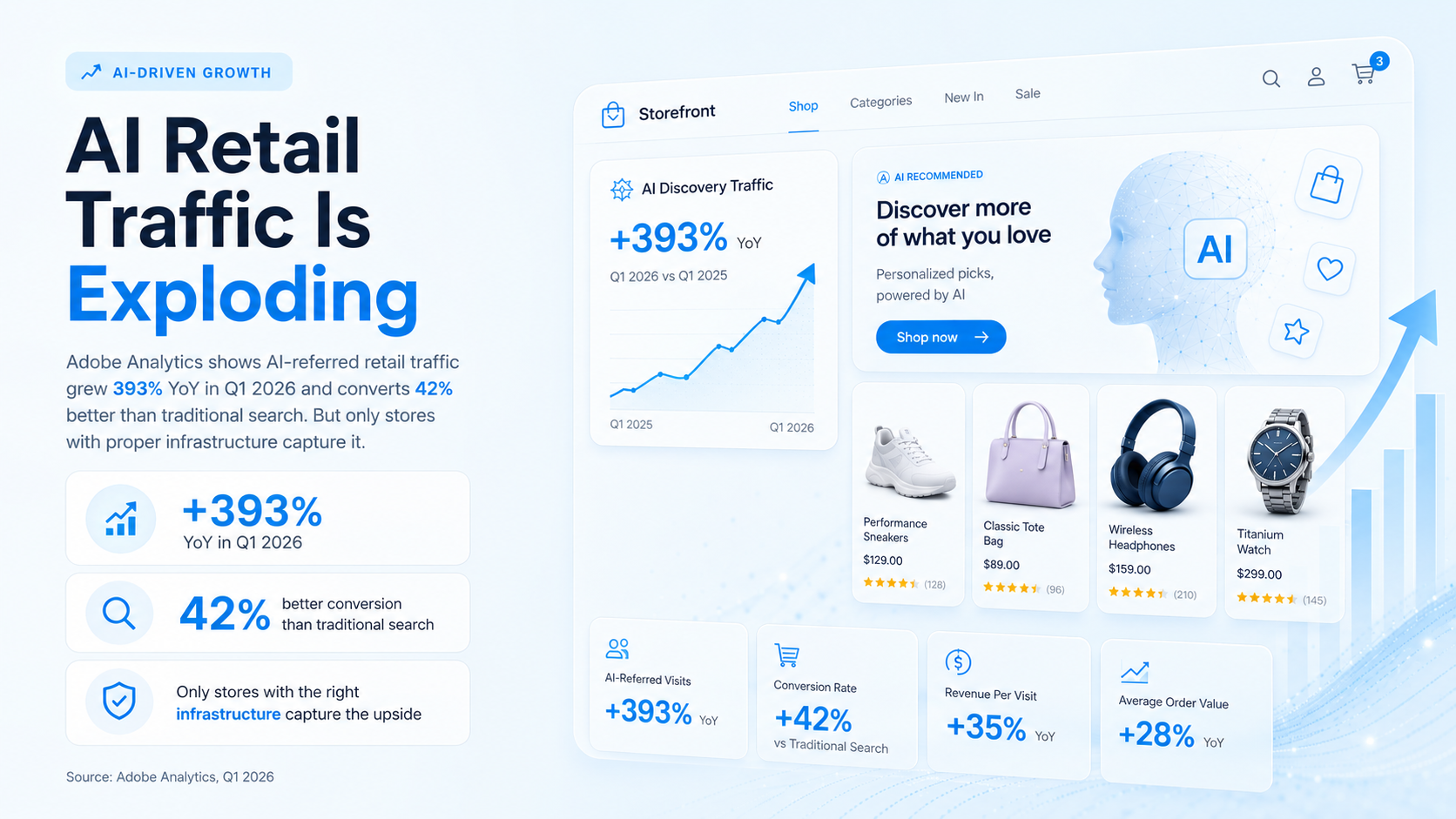
AI-referred traffic is up 393%. Is your store ready to capture it?
Retail traffic from Adobe Analytics from AI search…
Read →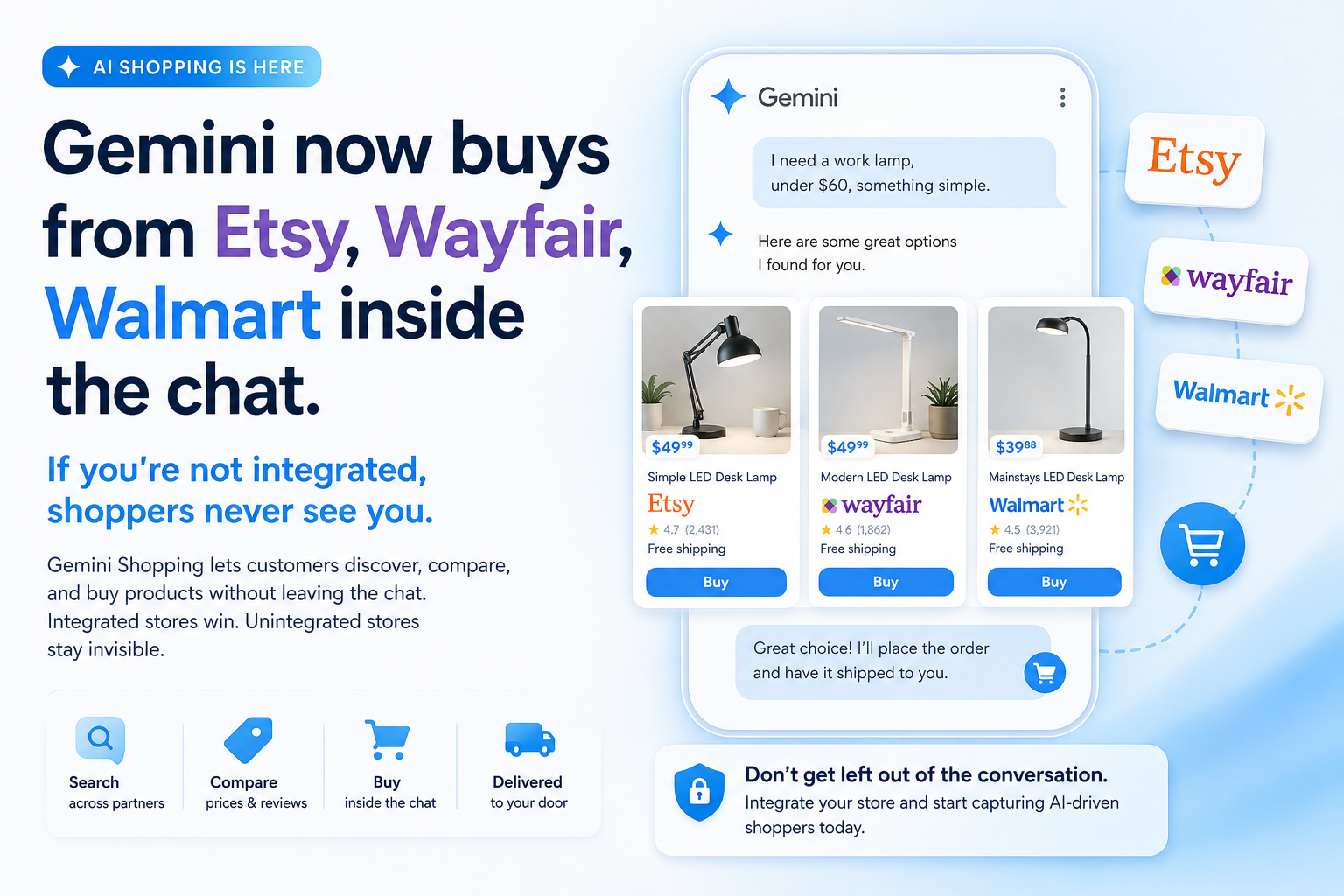
Google Gemini is taking orders. Your store isn't.
Gemini now buys from Etsy, Wayfair, Walmart inside…
Read →Put a sales agent on your store
It knows your catalog, recommends, takes orders — on your site and in ChatGPT. Built for you — live in days, not months.