
ChatGPT's 11.4% conversion rate beats every traditional channel—here's why
July 28, 2026 · 5 min read
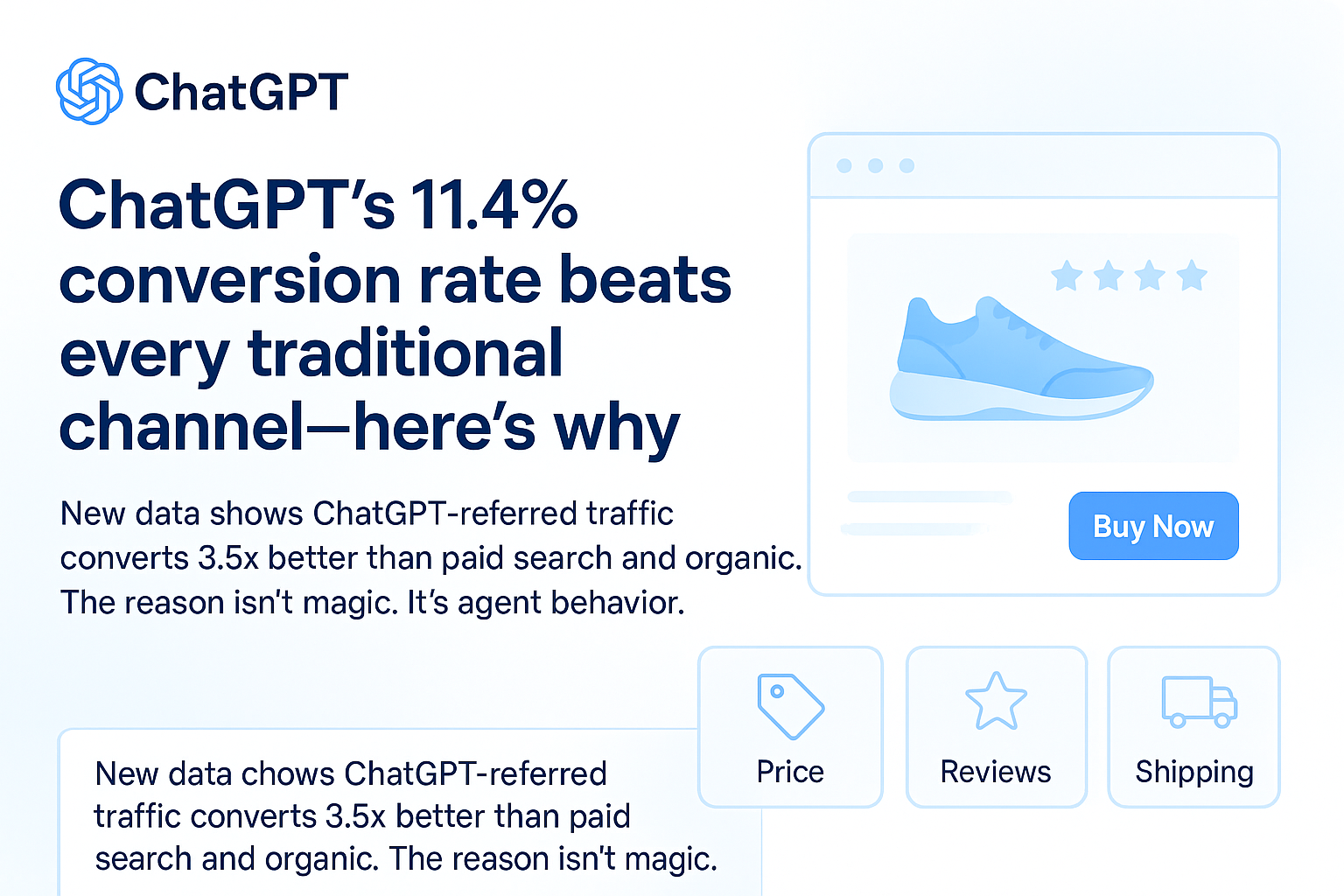
A shopper using ChatGPT to shop online asked the following question: I’m looking for a very lightweight running shoe for running. I need it to cost less than $150. I’d love to read the best reviews and have it to arrive very fast at my zip code. After searching through thousands of products online across hundreds of stores ChatGPT recommended 3 of the best options for the shopper. The shopper then clicked to buy one of the products recommended by the AI.
This is not new. But the numbers are.
Retail traffic generated by ChatGPT has converted at 11.4% over the last month. This number is higher than direct traffic (8.2%), paid search (4.1%), organic (2.8%), email (2.1%), display ads (0.6%), and social traffic (1.2%) as reported by Similarweb and ECDB for July 2026.
The numbers I have provided are real and the behavior described is happening right now. So while this is not new the fact that it is becoming the norm for the most qualified online shoppers is significant for anyone planning their shopping behavior online in 2026.
Why AI-referred traffic converts so much better
Shoppers that visit your online store via ChatGPT are fundamentally different from shoppers that visit your store via Google or Facebook.
Most Google traffic is generated from people searching for products online. A person searching for “running shoes” for example would land on your homepage. They would then browse around your site to compare with other 5 websites open in other tabs on their computer. Eventually they would leave your site with a conversion rate of 2-3%.
A shopper that has used ChatGPT to search for products has already done their research online and is looking for the best product. As a result the AI has filtered through all of the online stores to show them the best product or products from the best online stores. The shopper then lands on the product page of the online store where they have already decided to buy the product. All that the shopper needs to do is complete the transaction.
Conversion: 11.4%.
There is a huge difference between a shopper who types “running shoes” into Google and then clicks on a retailer’s homepage versus a shopper who has already had their questions answered by ChatGPT and then lands on a retailer’s product page for the same type of shoes.
AI’s remove friction to buying. AI’s answer shopper questions before shopper even asks questions. The most important part of all of this is that an AI audits out all available options for a shopper. The AI finds the best option for a shopper’s needs. Then the AI sends that shopper to a retailer’s product page that the AI audited for that shopper and found that retailer to be the best option for that shopper’s needs.
6. Readable Stores
Here is where most online stores fail.
Note that the AI does not “browse” your online store in the same way a human does. It does not click on buttons and scroll down pages. Rather, the AI is reading your site’s structured data. This means that it reads your online store’s product feed. It reads your online store’s pricing API. It reads through all of the reviews that you’ve accumulated and made available on your site. It reads through your online store’s shipping policy. It reads through your online store’s return policy. And it reads through your online store’s real-time inventory—item by item.
As the AI reads data from structured sources like product feeds, pricing APIs, aggregated reviews, shipping information, return policies, and current stock, it will very easily find a competitor that has already solved the problems a store faces when it comes to offering AI-referred traffic high converting traffic. The retailer with the machine readable high quality data will become discoverable to the agents, they will send the qualified traffic to the store, and the conversion rate will prove the value.
Data which is easily read by machines by virtue of being stored in a high quality, well structured and up to date form, is discoverable by agents and so drives highly qualified traffic to the online store of the retailer who publishes that data.
Stores without proper data infrastructure will remain invisible to the new fastest-growing channel for retail acquisition: AI agents.
What this means for the next 6 months
The conversion data is now public. And we have got the CFOs staring at the numbers. Retailers are now asking one simple question – Are we discoverable by ChatGPT? By Gemini? By Claude with tools?
The retailer will have 6 months of data on which agents acquire the best customers. Data on which products agents prefer. Data on how to optimize for agent queries. This will not close for the retailers who don’t optimize for agent queries after 6 months.
By the time stragglers get to see 6 months of data in February of 2027, that data will no longer be available for comparison. So, by the time retailers who have not yet started (invested) to set up data infrastructure for their online stores find out how others have been using that data to run experiments (to find answers to questions such as: which agents attract the best customers for their store, which of their products the various agents most prefer to talk about and link to, etc.), and then to optimize their website(s) for answering the queries that are posed by agents, stores that started investing in data infrastructure for their online stores as early as August/September of 2026 would have had already run countless experiments and would have already gathered a significant amount of data to draw conclusions from.
The gap will not close easily.
Today traffic from AI powered agents already accounts for 15% - 30% of new customer acquisitions for retailers that are optimizing for AI agent traffic already. However for all retailers this number is expected to increase over time to account for 40% - 60% of all new customer acquisitions for all retailers online by 2027.
What are you waiting for? The real question is not when AI agents will matter for your store. The real question is whether your store will be ready when they arrive.
What to do now
Step 1: Audit your data readiness. Dreamvention has created a free scan that will check your store and list out what information ChatGPT and Gemini agents can read about your store and what they cannot. You can run the scan at dreamvention.com/scan (30 seconds to get your results, no email required).
Step 2: Publish your data. Make sure your product feed, your pricing data, your customer reviews, your shipping information, your return information is all up to date and is published for the AI’s to read.
Step 3: Set up MCP. Model Context Protocol (MCP) is the industry standard for agents to query online stores. For WooCommerce and OpenCart stores, there are already several options available to set up MCP.
Step 4: Track agent-referred traffic – Tag in your analytics the traffic that is coming from AI agents. Then you can see the conversion rate of customers that are coming from specific agents and optimize your store for their queries.
That conversion rate is not a promise of things to come but a mark to aim for. The key to it all is treating your product data as a system to be worked with, and having your store viewed by the AI as a machine-readable catalog (MRC).
By the time the stragglers have set up shop for retail AI in February 2027, the early movers will have 6 months of conversion data. And, remember, the conversion rate for this new channel of retail acquisition is already publicly known for online stores that have set up their shop for retail AI correctly:
And so the question remains for all of us retailors….. will YOUR store be one of them?
Get AI Commerce Tips
5 expert tips to grow your store with AI agents.
No spam — unsubscribe with one reply.
Read next
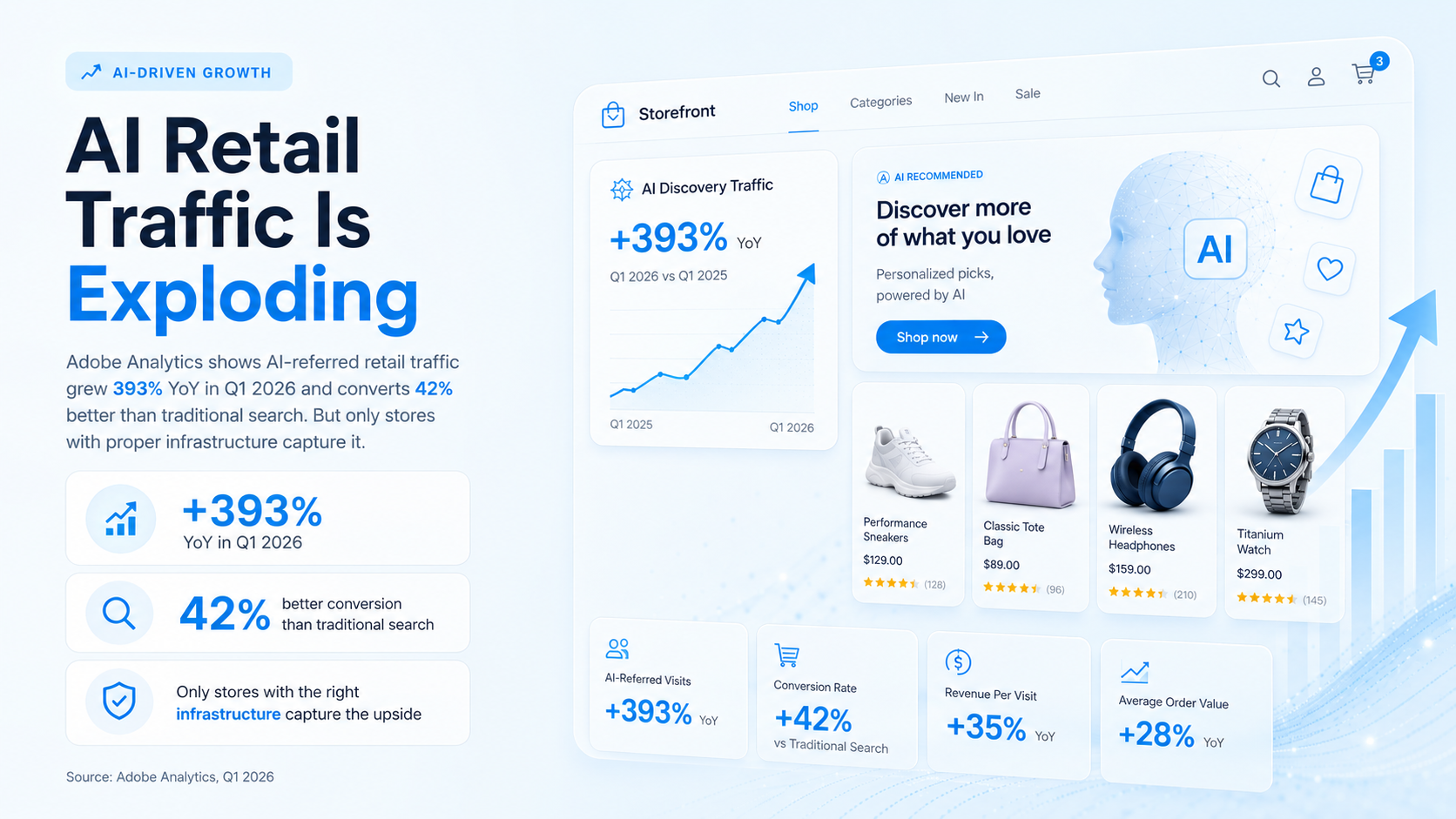
AI-referred traffic is up 393%. Is your store ready to capture it?
Retail traffic from Adobe Analytics from AI search…
Read →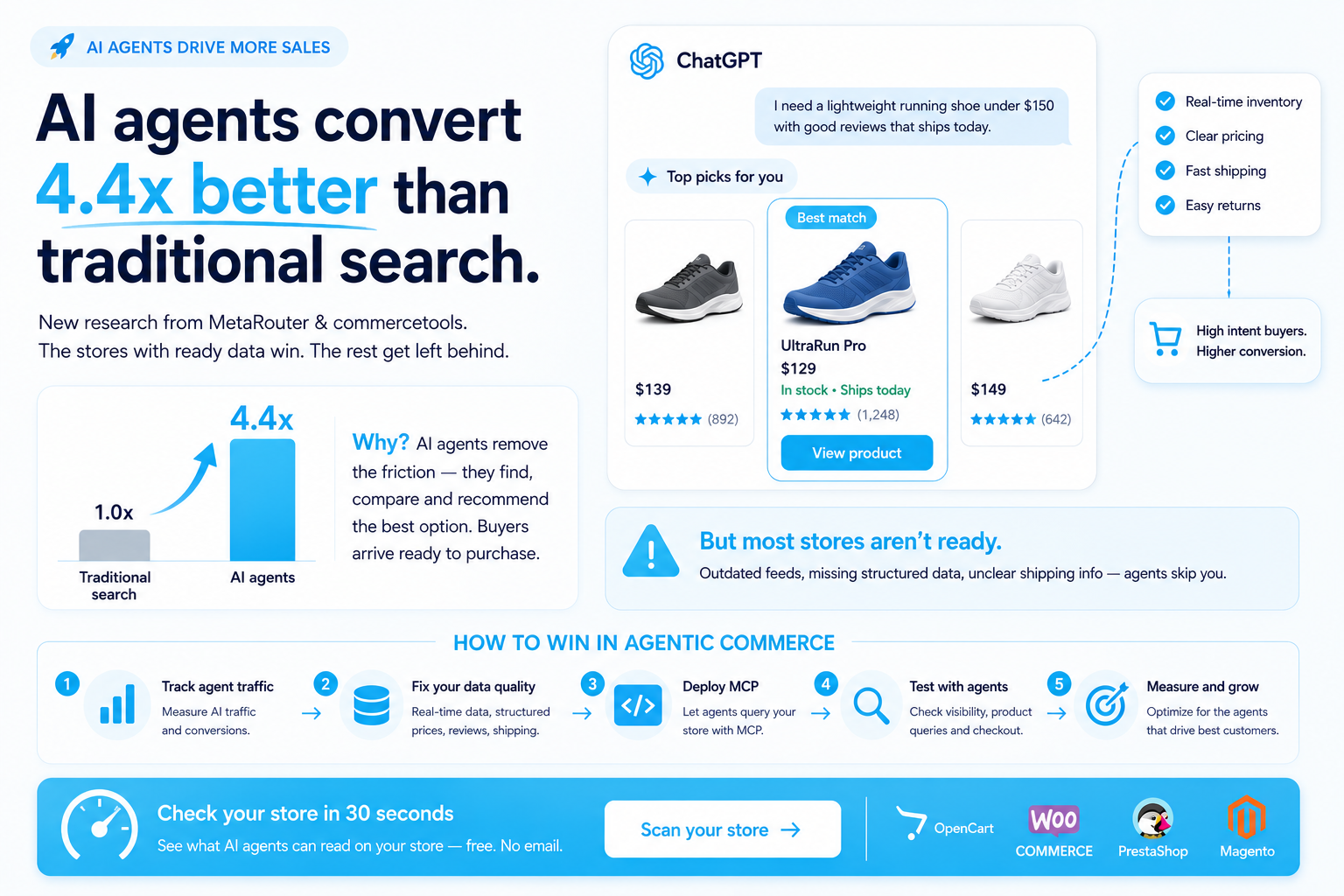
Agentic commerce has 4.4x conversion potential – but only if your data is ready
New research highlights the vast potential of AI p…
Read →
MCP 2026 Release Candidate: The new standard for AI agent ecommerce
Model Context Protocol hits its final specificatio…
Read →Put a sales agent on your store
It knows your catalog, recommends, takes orders — on your site and in ChatGPT. Built for you — live in days, not months.